Listen to James Vesper introducing the course objective and structure:
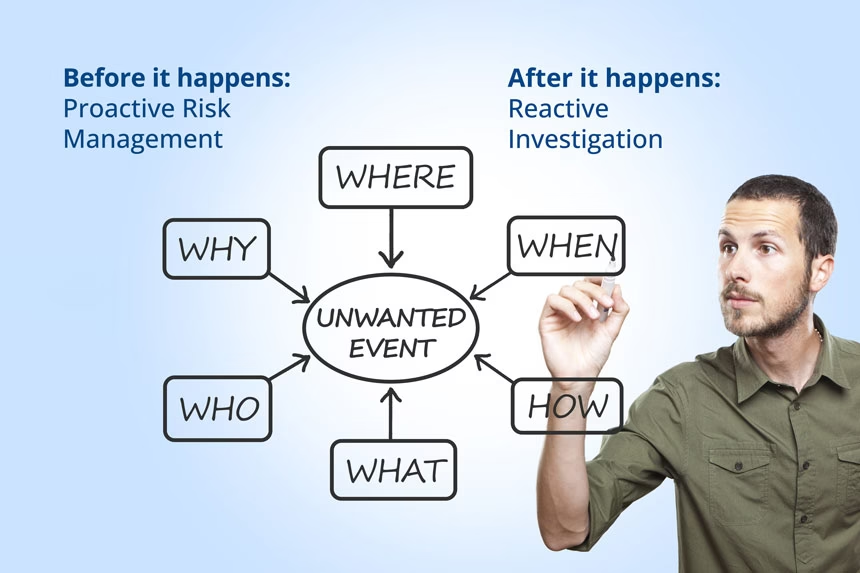
At first glance, quality risk management (QRM) and root cause investigations (RCIs) appear to be different: QRM is prospective – it looks ahead to anticipate what could go wrong and why, while RCIs are retrospective – they look at an event to determine why and how it occurred. But, viewing them more closely, QRM and RCIs have a similar purpose: understanding a situation well enough to prevent an unwanted event from happening or recurring. To achieve this common goal, many of the tools and methods are the same but used in just a slightly different way.
This three-day workshop, useful for those working in pharma, biopharma, medical device, and product distribution, provides an overview of QRM and RCI and the respective regulatory expectations. Participants will use a selection of prepared case studies to challenge their critical thinking skills as they use some of the tools.
Topics include
- The “big picture” of QRM and RCIs
- What often goes wrong and why
- How QRM and RCI have evolved
- Comparing QRM and RCI: where the differences are
- The connection to knowledge management
- Formal and informal methods and tools; when to use
- “Human error” is not a valid root cause
- Tools and methods (along with examples and case studies):
- Cognitive interview process
- Structured observation
- Failure mode effects analysis (FMEA)
- Fault tree analysis
- Event tree analysis
- Causal factors charting and analysis
- Visualization techniques
- Five whys
- Risk communication
- Challenges unique to QRM: scales
- Corrective and preventive actions (CAPAs)
- Closing the loop: effectiveness checks
Learning objectives
- Define important terms used in QRM and RCIs.
- Identify the similarities and differences between quality risk management and root cause investigations.
- Discuss examples of deficient QRM studies and RCIs.
- Discuss regulatory requirements for QRM and RCIs.
- Differentiate between formal and informal methods and when each is appropriate.
- Describe the key activities in QRM and RCIs and how they are achieved.
- Given a tool or method, describe how it can be used in a proactive or retroactive situation.
- Given a case or situation, use a tool or method to “solve” the case.
- Identify ways that the participant can use the information in their professional practice.
Workshop/instructional description
- The workshop will use a variety of methods to enhance participation and application of the content, including individual and group activities, discussion, case studies, and instructor presentations. The first two days will be approximately seven hours of instructional time; the third day will have approximately six hours.
Suggested audience
- Those involved in quality risk management or incident investigations; quality unit personnel and their management. The course is applicable to pharma, biotech, medical device, supply chain, and product distribution.
Your instructor
James Vesper, PhD, MPH will lead the workshop. Dr. Vesper has had more than 40 years experience in the pharmaceutical industry and has trained industry and health authority personnel in Europe, Asia, North and South America, and Africa and authored or co-authored numerous articles and books, including Root Cause Investigations for CAPA (2020) and Quality Risk Management – A Practical Guide (2025). During his career, he has spoken at numerous international conferences including WHO training events and PIC/S QRM Expert Circle meetings; he has led numerous face-to-face and virtual courses for GBA Key2Compliance.
#5334