Biological Safety Support throughout the Medical Device Lifecycle

September 29, 2026
Lab bench with a microscope, computer screen, and samples

Is your Biological Evaluation Documentation ready for the latest ISO 10993 expectations?


Biological safety is not a one-time regulatory activity. Throughout the medical device lifecycle, manufacturers must continually assess whether existing biological safety evidence remains sufficient as standards evolve and devices, materials, suppliers, and processes change.

Regulatory expectations continue to evolve throughout the medical device lifecycle, and updates to standards, guidance documents, and scientific understanding may require manufacturers to reassess their biological evaluation strategy and supporting documentation. 

In particular, manufacturers may need to review existing documentation in light of the latest ISO 10993-1 requirements and expectations for a risk management-based biological evaluation process.

In addition, changes to materials, suppliers, manufacturing processes, sterilization methods, packaging, device design, intended use, or patient-contacting components can all trigger the need for a biological safety assessment and an evaluation of whether existing evidence remains sufficient.

In these situations, the key question is often not simply which biocompatibility tests should be performed. Instead, the challenge is determining what biological safety evidence is required, what can be justified using existing information, and whether additional testing is truly necessary.

At GBA Key2Compliance, we help medical device manufacturers develop risk-based, scientifically justified biological safety strategies that align with ISO 10993 and current regulatory expectations. By combining expertise in biological evaluation, analytical chemistry, exposure assessment, and toxicological risk assessment, we support scientifically sound decision-making and help identify the most appropriate path to demonstrating biological safety.

Our goal is to determine what evidence is needed to support a scientifically justified biological evaluation, making full use of existing information and avoiding unnecessary testing whenever possible.

How we can support you

Our services include:

  • Biological Evaluation Plans (BEPs) and Biological Evaluation Reports (BERs)
  • Biological safety strategies and biological effect assessments
  • Gap assessments of existing biological safety documentation
  • Review and integration of material, supplier, chemical, and biological data
  • Biological impact assessments of changes to materials, suppliers, manufacturing processes, sterilization methods, packaging systems, device design, and intended use
  • Testing strategies, including scientific justifications when additional testing may not be required
  • Chemical characterization and toxicological risk assessments
  • Bridging and equivalence assessments
  • Support in responding to questions from Notified Bodies and regulatory authorities
  • Investigation and assessment of unexpected, equivocal, or failed biocompatibility test results

Before you test - understand the Gap

When a biological safety question arises, additional testing should not automatically be the first step.

A sound evaluation starts by understanding what has changed, which biological risks may be affected, what evidence already exists, and whether that evidence remains relevant to the current device.

Historical biological test data, material and supplier information, chemical characterization, toxicological assessment, scientific literature, manufacturing knowledge, complaint history, post-market surveillance data and post-market experience may all contribute to the evaluation. In some cases, existing evidence can support the assessment without further testing; in others, targeted additional data may be necessary.

Our role is to critically assess the available evidence, identify the remaining gaps, and define a scientifically justified biological evaluation strategy. When additional testing is warranted, we help ensure that it is relevant, appropriately designed, and integrated into the overall biological safety assessment.

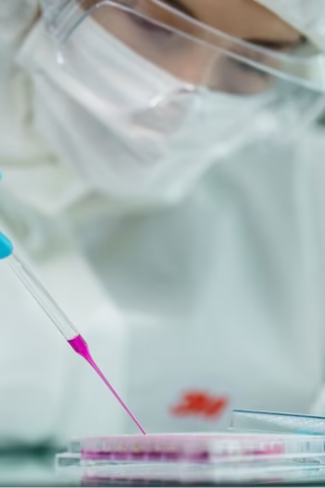
Kvinna i labb

Access to both Consulting and Laboratory Expertise

As part of GBA Key2compliance, we have direct access to specialized laboratory expertise and a broad range of biological and chemical testing capabilities. We also collaborate with qualified external laboratories when a specific method, technology, or project requires it.

This flexibility allows us to support projects of any size, from targeted reviews and second opinions to complete biological safety programmes covering product development, regulatory submissions, design changes, post-market activities, and lifecycle management.

Is it time to revisit your Biological Evaluation?

Was your BEP or BER prepared under an earlier version of ISO 10993-1?

Have you changed a material, supplier, manufacturing process, sterilization method, package, design, or intended use?

Have you received a question from a Notified Body or regulatory authority?

Have you obtained an unexpected or failed biocompatibility result?

Are you being asked to perform additional testing and want to understand whether it is scientifically necessary?

We can help you determine what evidence you already have, what gaps genuinely remain, and the most scientifically justified path forward for your biological safety evaluation.

Whether you are updating legacy documentation, assessing a design change, responding to regulatory questions, investigating biological test results, or planning a new testing strategy, we can help define the most efficient and scientifically justified path forward.

Contact us to discuss your biological safety challenge.

Search

Search